
Interview – Whispers of the Soul – With Valérie Six, Co-founder of Au contraire productions
With Whispers of the Soul, Isabelle Adjani, a leading figure in French theatre and cinema, explores the art of reading aloud as an intimate and deeply moving experience. Valérie Six, the producer behind this creation, comes from the world of publicly funded theatre (La Salamandre – Théâtre du Nord, the Odéon Theatre, the Avignon Festival and the Aix-en-Provence Festival of Opera). She has specialised in communications and fundraising while also dedicating the past ten years to adapting and developing texts and initiating artistic projects.
Led by Isabelle Adjani’s voice, reading becomes a space where words and audiences meet, where diction, attentive listening and music come together to create a moment that is both fleeting and deeply memorable. The production brings together texts by Françoise Sagan, Marguerite Duras, Anne Dufourmantelle, Camille Laurens and Patrice Chéreau, among others. These works explore the many dimensions of the feminine experience, from adolescence to adulthood, as well as the different facets of love, desire and emancipation.
FdFK: How did the Whispers of the Soul project come about, and what inspired you to make reading aloud the central element of this production ?
Valérie Six : "It's a lovely story. When I first met Isabelle, the director of the Odéon Theatre, where I was working at the time, already had a project in mind with her. Before embarking on that project, which was planned for the following season, she had told him that she wanted to reconnect with theatre, go and see performances and find her way back to the stage, but that she no longer really knew which projects to discover or which directors to follow. The director then put her in touch with me. I suggested: 'Why not reconnect with the stage and the performing space through readings while waiting for the next project?' Patrice Chéreau had passed away a year earlier. He was an extraordinary theatre director and filmmaker, one of the most important figures of the twentieth century. Those of us working in theatre had been captivated, fascinated and swept away by this man. He was extraordinary. I was very close to Patrice, and after his death I had organised a reading of his texts with Dominique Blanc as part of France Culture's programme at the Avignon Festival. There aren't many books by Patrice Chéreau, but what he wrote is fundamental. Isabelle had also worked with him in cinema and knew how close we were. When I suggested doing readings, she immediately said she was interested. I told her I could find directors for her, as I was the Director of Communications at the Odéon at the time. I had organised that first reading with Dominique Blanc out of affection, friendship and admiration for Patrice, but I didn't consider it to be my profession. Isabelle replied: 'But I want to do it with you.' I said: 'Yes, but that's not really my job.' She reminded me that I had already organised a reading with Dominique Blanc and that if I had been able to do it with her, I could certainly do it with Isabelle. That's how it all began. We organised two series of readings at the Bibliothèque nationale de France. They were very successful; people absolutely loved them. We talked a great deal during that period and shared our literary tastes, favourite authors and the texts we loved. Gradually, certain themes began to emerge, with many women writers and a variety of subjects we wanted to explore. The project took shape progressively. Initially, there wasn't necessarily any intention to create a reading performance centred on femininity. That dimension developed through our collaboration with Isabelle, truly hand in hand. I always say that this reading was crafted like a haute couture dress: every detail was painstakingly stitched together. I also continue to evolve it according to current events, which is part of what makes it so interesting. Some people have seen two or three different versions. There is always a central core, usually texts by Duras and Sagan: at least one of the two remains, and often both. The other texts, however, can change and evolve depending on current events and the subjects that particularly resonate with Isabelle, whether on a personal or societal level."
Why did you choose to bring together texts by such different writers as Françoise Sagan, Marguerite Duras, Anne Dufourmantelle, Camille Laurens and Patrice Chéreau? What is the common thread running through them ?
Valérie Six : "There are several starting points. First, Sagan and Duras. Isabelle was fortunate enough to know both women, and she adored them. She genuinely loved them both and felt a particularly strong connection with Sagan. The Farewell Letter was actually something she brought to the project herself. She has always loved it and has great fun performing it. Then there is the fact that we both have a very strong connection to psychoanalysis. I introduced her to Anne Dufourmantelle and her book In Praise of Risk. She was an extraordinary woman. Isabelle and I share an attraction to women who are deeply alive, authentic and committed, such as Cynthia Fleury, whom Isabelle introduced me to. In fact, last year we created a wonderful project based on a text by Cynthia Fleury, an excerpt from which we have included here: The End of Courage. It is a beautiful text about the feeling of having completely lost one's courage. Perhaps by accepting that feeling, we can begin to find it again, approach it and discover what it really means. We tend to say 'good luck' or 'be brave' all the time, without necessarily knowing what courage actually is. We often encounter it when going through genuine hardships, and its form can be surprising. There are people we might never have expected to show such strength during difficult times who turn out to be extraordinarily courageous. Then there is Neige Sinno. Her book Sad Tiger completely floored both Isabelle and me. Beyond the writing itself, the reality she describes left a profound impression on us. It was Isabelle who suggested turning her back to the audience, and I thought it was a beautiful idea. I had attended a presentation of Neige Sinno's book at the Maison de la Poésie. Whenever she had to speak in the first person, using the word 'I', she would put on a mask, because reclaiming that 'I' and making it visible felt almost too violent. I thought it was wonderful that Isabelle should adopt this principle and give voice to such a powerful subject. There was also a time when Isabelle called me in the middle of the night. She was looking for a text from a mother to her son, something that might echo a reality she almost never speaks about. It is a pain experienced by so many mothers: the pain of losing a child. I remembered an interview I had once seen on television and managed to track down a text by Roselyne Febvre entitled The Hummingbird's Heartbeats. This text echoes the death of Cindy Crawford's son, who was a friend of Isabelle's son. It is therefore a deeply personal and moving confession for her. The Afghan poet's contribution came from a project we had worked on as part of the Year of Poetry, which was dedicated to Afghanistan. We had both been given access to Afghan poetry and discovered this poem, written by a very young woman at the time the Taliban returned to power. It was extremely important to Isabelle to give a voice to this woman. Finally, we also chose Gisèle Halimi. We were very proud to present this text because her words have not lost any of their relevance. Whether you read her early writings or this particular text, they really make you stop and think. As she says, there will never be enough of us reminding women to take ownership of their lives and their realities. The first area targeted when freedoms are restricted is always women's position in society. We can see this with the return of many authoritarian regimes: one of the first measures often concerns abortion. We really must remain vigilant. Courrier international published a world map showing how women's rights were regressing. We have to remain committed activists, because nothing can ever be taken for granted. Ultimately, the common thread emerged through our shared sensibilities, our encounters with these texts and our desire to give a voice to words that we believe are essential. The writers may be different, but they all share the ability to make us reflect on ourselves."
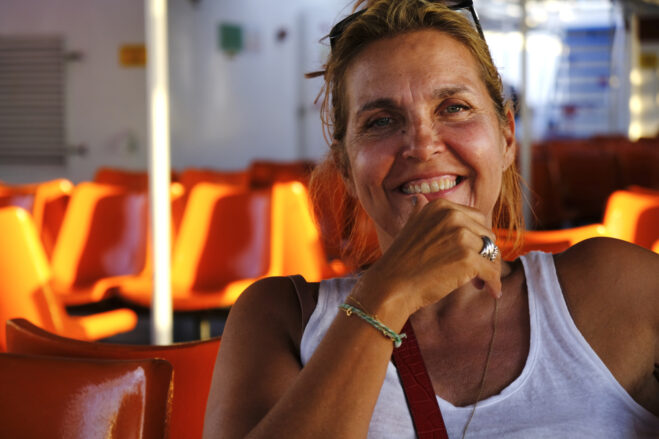
FdFK: The project is built around texts that have had a profound impact on Isabelle Adjani's thinking and personal journey. What does Isabelle Adjani's performance bring to these texts ?
Valérie Six : "Isabelle is timeless. She is a point of reference across generations, almost a mythical figure. I have a friend who is a filmmaker and teaches at a major film school in Japan. He teaches acting, interpretation and the art of embodying a character. He told me that, during his very first class, he showed excerpts from films featuring Isabelle Adjani. For him, she is the absolute benchmark for acting. In Whispers of the Soul, she can move from speaking on behalf of high school students to representing women, and then go on to embody a man. She gives life to an extraordinary range of perspectives. The power of words has profoundly shaped her life. It has guided her reflections on the place of women, but also on that of men. Take Anne Dufourmantelle's text, for example. Isabelle has an absolutely remarkable way of conveying male vulnerability and distress. I had already heard the text performed by someone else, but that interpretation hadn't really made me connect with the male perspective. With Isabelle, we understand this man's distress and confusion. He acknowledges that perhaps he gained access to his own emotional world through meeting his wife, but he cannot move beyond that realisation or truly acknowledge her pain. He thinks that simply addressing the problem is enough to make it disappear. I believe Isabelle has this extraordinary ability to capture sensitivity and translate emotion. She doesn't simply speak the words: she gives them depth and brings them to life, allowing us to understand the different layers of a text and its characters."
FdFK: The project gives particular prominence to texts exploring femininity and its many different realities. What guided this approach, and what does Isabelle Adjani hope to bring to the surface through these texts ?
Valérie Six : "This dimension developed gradually, through our conversations with Isabelle. Initially, there wasn't necessarily any intention to create a reading performance centred on femininity. It was through sharing our tastes, favourite authors, texts and interests that certain themes began to emerge. We therefore share an attraction to women who are intellectually and philosophically profound, as well as a common interest in psychoanalysis and literature. Through the texts of Gisèle Halimi, Cynthia Fleury and Anne Dufourmantelle, for example, different realities came together: women's freedom, courage, vulnerability, everyone's place in society, and the relationships between women and men. What matters is giving a voice to words that move us and continue to make us question things. But this is not simply about putting forward an activist message. It is also about giving expression to human experiences, emotions and contradictions. In Anne Dufourmantelle's text, Isabelle manages to convey a man's distress and make us sensitive to what he is going through, without erasing his wife's pain. I think this is essential: these texts do not confine us to a single way of thinking. They invite us to question ourselves, to recognise aspects of our own experiences in certain situations, and to understand both our own feelings and those of others. Isabelle and I built this reading performance together, guided by our shared sensibilities and the subjects that matter to us, whether personal or societal. Some texts also evolve over time, depending on current events or what particularly resonates with her. The idea is to give these voices an opportunity to be heard and let the words speak for themselves. They can move us, challenge us and make us reflect on our own lives. It is precisely this encounter between the texts and Isabelle's sensitivity that gives them their power."
FdFK: What artistic and staging choices did you make to preserve the full power of the texts and the sense of intimacy that Isabelle Adjani seeks to create ?
Valérie Six : "First of all, I am passionate about film scores and classical music. I therefore created a genuine musical tapestry, which sometimes introduces a text and sometimes highlights a shift or rupture within it. I absolutely love doing that. Isabelle does too, because she tells me that it makes her feel as though she has someone alongside her on stage, almost as if the music were accompanying her. We also worked extensively on the lighting and on the idea of having a chaise longue. We wanted a sofa on stage that would also evoke the couches found in psychoanalysts' consulting rooms. We wanted this object to feel like another character, present on stage. We wanted to preserve a sense of simplicity. Isabelle doesn't remain entirely behind the lectern: she moves from one side of the stage to the other, picks up the text and looks at the audience. These are very simple gestures, but they bring the words to life. When we use the term 'reading', people might imagine someone simply reading a text to themselves. Yet there is an enormous amount of interpretation involved in this exercise. We therefore spent a great deal of time exploring what each text actually meant to Isabelle and what it brought out in her. I can see this particularly clearly in Anne Dufourmantelle's text. Over time, Isabelle has given the male character greater physical presence and sensitivity, whereas initially she gave him less. As you immerse yourself in the sentences and the words, you begin to hear new things. And we ourselves evolve too. Isabelle can sometimes have quite a fast delivery, but the more she performs these texts, the more they become like old friends she is meeting again. She gives them more time and allows herself to slow down. This completely transforms the way we listen. We hear texts differently when the person speaking them fully experiences their nuances. For me, it is also a form of communion. I am not religious, but I feel that, in this experience, the word 'together' takes on its full meaning."
FdFK: At a time when cultural practices are constantly evolving, what can such a simple and direct encounter between a text, a voice and an audience bring to artistic creation today ?
Valérie Six : "As you rightly pointed out, this direct encounter is precisely at the heart of Whispers of the Soul. Some people have told me that they felt as though Isabelle was speaking directly to them, personally, as if she were addressing them alone. We wanted to reach people at an emotional level. I remember working with Isabelle on Cynthia Fleury's text when, one day, I told her: 'Actually, this is what I want to achieve in my life: to make audiences feel uplifted without ever talking down to them.' That's exactly it. You feel elevated, nourished and enriched. But we are not there to teach anyone a lesson. What brings me immense joy is when people leave the performance feeling as though they have been filled with so many things, as though they are taking something meaningful away with them. The reading itself is very simple and unpretentious, but it involves an enormous amount of work. You have to find the texts, choose the music, determine the rhythm and construct a kind of narrative. I have the impression that there is a woman, embodied by Isabelle, who moves through different texts and subjects, leading us to think: 'How interesting she is! How much I like her! How much what she says resonates with me!' It is as though she were inviting us to recognise ourselves in everything she shares. The performance is experienced by a diverse audience, yet each person can have the feeling of being alone with her. That is precisely what we wanted to achieve."